Featured Image Note: `images/05-ces-2026-robots-hero.png` — CES exhibition scene with AI companion robots for hero/header placement.
At CES 2026 in Las Vegas, something unusual happened.
Walking through the AI companion robot section, you didn't see the usual suspects — the Boston Dynamics demos, the Sony Aibo booth, the sleek-but-vague "AI assistant" concepts from big tech. Instead, the most crowded booths belonged to a wave of Chinese startups most attendees had never heard of. Eighteen of them, by one count.
They weren't showing PowerPoint decks. They were showing products that shipped — or were weeks away from shipping — at prices that made Western competitors visibly uncomfortable.
This is worth studying. Not because CES is where products succeed (most don't), but because the patterns visible in that Las Vegas convention hall reveal exactly how China's AI hardware machine works at full speed.
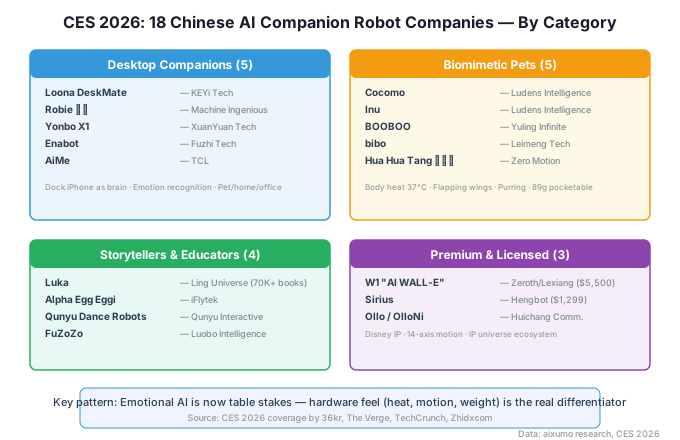
A visual map of all 18 Chinese AI companion robot exhibitors at CES 2026, grouped by category. The diversity of form factors — from 89g pocket charms to $5,500 WALL-E robots — shows a market finding its shape in real time.
The 18 Companies: A Taxonomy
Here is every company that showed an AI companion robot at CES 2026, grouped by what they're actually trying to do:
Category 1: Desktop Companions (The "Work-From-Home Friend")
| Product | Company | What Makes It Interesting |
|---|---|---|
| Loona DeskMate | KEYi Tech | Docks your iPhone as its brain. No built-in screen/camera/mic — uses yours. 180W fast charger included. |
| Robie (糯宝) | Machine Ingenious | Pupil dilation on surprise, "dizzy" expression when shaken, dual face+voice recognition in noisy rooms |
| Yonbo X1 | XuanYuan Tech | 12-DOF motion, personality system parents can customize, homework tutoring, age-adaptive content |
| Enabot | Fuzhi Tech | Triple function: pet companion (laser play) + home security patrol + video calls. 6 character modes, 20+ dialect accents |
| AiMe | TCL | Cartoon body on wheeled base. Emotion recognition via head camera → adjusts eye expressions. Night patrol mode. |
Category 2: Biomimetic Pets (The "It Feels Alive" Crowd)
| Product | Company | What Makes It Interesting |
|---|---|---|
| Cocomo | Ludens Intelligence | Wheeled robot pet that follows you. Body heated to 37°C (39°C when touched). Communicates via purring, not language. |
| Inu | Ludens Intelligence | Desktop "alien puppy." Tail wag, blinking animations. Sound + touch triggers. |
| BOOBOO | Yuling Infinite | Flapping-wing flying companion. Emotion recognition + light/motion/voice response. Indoor-safe. Gen Z NASA-background founder. |
| bibo | Leimeng Tech | LABUBU-meets-AI aesthetic. Face/voice/gesture recognition. Emotion AI triggers proactive interaction. |
| Hua Hua Tang (话话糖) | Zero Motion Future | 89g pocket companion. Has body temperature, memory, gets hungry. "Bump to make friends." Digital Tamagotchi for Gen Z. |
Category 3: Storytellers & Educators
| Product | Company | What Makes It Interesting |
|---|---|---|
| Luka | Ling Universe | Reads 70,000+ picture books automatically. English + Chinese modes. Multiple narration styles. |
| Alpha Egg Eggi | iFlytek | Gamified pet-raising through exercise. Earn coins, unlock skills, experience "rebellious phase." Emotion + growth arc. |
| Qunyu Dance Robots | Qunyu Interactive | 18-robot synchronized Yingge dance troupe. Was pre-programmed, now uses LLM for real-time audience adaptation. |
| FuZoZo | Luobo Intelligence | Plush bag charm with LLM. Chat + "tap to add friends." Targets young adults living alone. |
Category 4: Premium & Licensed
| Product | Company | What Makes It Interesting |
|---|---|---|
| W1 ("AI WALL-E") | Zeroth / Lexiang Tech | Disney-licensed WALL-E design. Indoor+outdoor. Fall detection, camping companion, music sharing. ~$5,500. |
| Sirius | Hengbot Innovation | 14-axis quad robot dog. Custom Neurocore joints. $1,299. Soccer + dance + behavioral evolution. |
| Ollo / OlloNi | Huichang Communications | IP-universe bot family. Cone-shaped static companion + neck-extending expressive variant. Behavioral model evolves over time. |
Three Patterns Every Hardware Founder Should Understand
Pattern 1: Heat = Trust
This is not a coincidence: Cocomo (37-39°C), Ropet (37°C), Sirius, and Hua Hua Tang all emphasize body temperature. Warmth is the fastest shortcut to making a machine feel alive. The engineering challenge is non-trivial — sustained 37°C in a small battery-powered enclosure requires careful thermal management — but the payoff is disproportionate.
Lesson for founders: If your product involves physical interaction, warmth is the highest-ROI hardware feature you can add. It costs more in BOM than you think. Plan for it early.
Pattern 2: Emotional AI Is Now a Commodity — Differentiation Is in the Hardware
Every single product at CES 2026 had "emotion recognition," "personality systems," or "adaptive behavior." The AI stack — LLM integration, voice emotion detection, facial expression analysis — is no longer a differentiator. It's table stakes.
The products that stood out were the ones where the hardware itself created the emotional response: BOOBOO's flapping wings, Cocomo's purring, Hua Hua Tang's 89g pocketability, W1's WALL-E silhouette.
Lesson for founders: Don't lead with your AI model. Lead with the physical experience. The AI makes it work; the hardware makes people care.
Pattern 3: Chinese AI Hardware Iterates in 6-8 Weeks
Several of these companies told journalists they went from concept to CES-ready prototype in under three months. That speed isn't magic — it's the Shenzhen supply chain, where:
- PCB fabrication takes 24 hours (not 2 weeks)
- Injection mold modifications happen in days (not weeks)
- Component distributors are a Didi ride away in Huaqiangbei
The Western hardware startup that takes 6 months to iterate will get lapped 3-4 times by a Shenzhen team in the same period.
The Technology Stack Behind the Boom
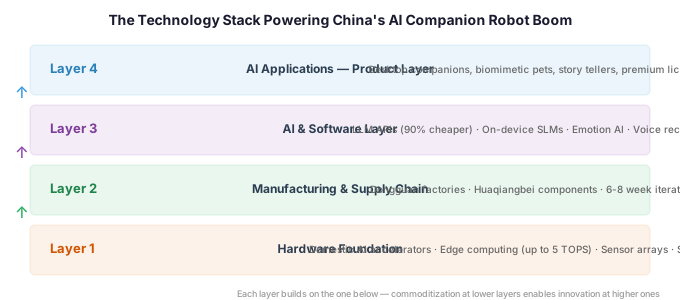
China's AI companion robot ecosystem is built on four converging layers. The commoditization at each lower layer — cheaper chips, faster manufacturing, cheaper LLM APIs — enables the explosion of product diversity at the top.
What makes these products possible? Four converging forces:
1. LLM API Costs Have Collapsed
The cost of running an LLM inference dropped 90%+ between 2023 and 2026. A toy that would have cost $5/month in API fees to operate now costs pennies. This is the single biggest enabler of the AI toy boom.
2. On-Device Small Language Models (SLMs)
For privacy-sensitive products (children's toys especially), on-device SLMs running on domestic AI accelerators eliminate the need for constant cloud connectivity. The toy works offline, responds in milliseconds, and doesn't send audio to a server. This is a regulatory requirement for the China market — and increasingly for EU/US markets too.
3. Emotion AI as a Service
Multiple Chinese AI companies now offer emotion recognition APIs — voice tone analysis, facial expression classification, sentiment detection — that can be integrated into a product in days. The frontier has shifted from "can we detect emotion" (solved) to "what do we do with that data" (the product design challenge).
4. The Dongguan Factory Ecosystem
Dongguan isn't just a manufacturing city. It's a vertically integrated AI hardware hub where the plush toy factory, the PCB assembler, the injection molding shop, and the packaging designer are all within 30 minutes of each other. This physical density enables the 6-8 week iteration cycles that define the market.
What This Means for Overseas AI Founders
The CES 2026 lineup is not a threat — it's a playbook. Here's how to read it:
If you're building an AI companion product: You're competing with companies that can ship from concept to CES booth in 12 weeks at a $30-300 price point. Your advantage is not in the AI — it's in brand, distribution, and cultural fit for your market. The hardware should be sourced from the same Shenzhen ecosystem your competitors use.
If you're building an AI product in another category (wearables, health, home): The AI toy market is your early-warning system. The component price drops, the SLM breakthroughs, the emotional AI commoditization — all of it will hit your category next. Watch the toy market to see what's coming.
If you're building anything that involves physical interaction: The "warmth = trust" pattern is category-agnostic. An AI health wearable that stays at body temperature, a smart home device that responds to touch — these are the same emotional engineering principles, applied to different verticals.
Golden sentence: "The AI that wins isn't the smartest model. It's the one you want to hold."
Building Your Own AI Hardware Product?
The same Shenzhen ecosystem that produced every product at CES 2026 is available to you — if you know how to navigate it. We help overseas AI founders go from prototype to production with the right factory, the right BOM, and the right timeline.
[Book a Free Assessment Call →] NDA signed first. No commitment. Let's talk about what you're building.
This is part five of aixumo's Insights series. Read Part 4 for the full breakdown of China's $18B AI toy market.
Whether you have a working prototype or just a hypothesis about what your users want to hold, Aixumo can map the path forward.
Share your current stage. We'll help you identify the hardware route, productization risks, and the practical next move before you spend money on the wrong supplier conversation.