A U.S. company wired $800,000 to a trusted Chinese supplier. The factory vanished. No product. No recourse. This is the new normal — and it's preventable. Here's what every AI hardware founder needs to know before sending money to Shenzhen.
In 2025, a U.S. startup wired $800,000 to a Chinese supplier it had worked with for years. The factory shut its doors the next week. The owner disappeared. The American company had a generic contract drafted in California, unenforceable in Chinese courts. Total loss: $800,000. Legal recourse: zero.
This isn't an outlier. It's the 2026 reality of manufacturing in China.
The landscape has fundamentally shifted. Factory insolvencies are rising. IP misappropriation has become a survival strategy for struggling manufacturers. Trademark hijacking is back, more sophisticated than ever. And small companies — the AI hardware startups with $50K-200K to spend on their first production run — face disproportionate danger because they skip the protective steps that large multinationals take for granted.
But here's the paradox: China is still the best place to build AI hardware. Shenzhen's component density, manufacturing speed, and cost efficiency remain unmatched. The question isn't whether to manufacture in China — it's how to do it without getting burned.
This article maps the 7 pitfalls that kill AI hardware startups, with real cost figures and specific safeguards for each one.
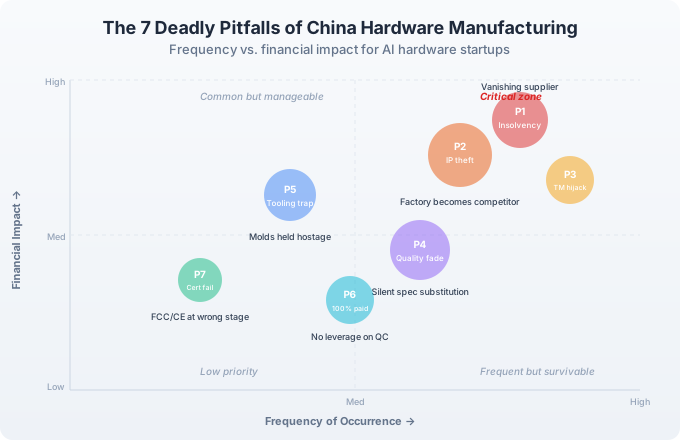
Pitfall 1: The Vanishing Supplier (Factory Insolvency)
What happens: You place an order, wire a 30-50% deposit, and the factory goes dark. Not because they're scamming you — because they went bankrupt. China's economic slowdown, weakening domestic demand, and real estate crisis have triggered a wave of factory collapses. Suppliers that seemed stable six months ago are insolvent today.
Real cost: Total loss of deposit. For a 5,000-unit run at $40/unit, a 30% deposit is $60,000. If the factory vanishes, that money is gone. You also lose the 6-8 weeks of lead time, which means missing your launch window.
The 2025 escalation: Harris Sliwoski LLP, a law firm handling China manufacturing cases, reports a "sharp surge in cases where manufacturers take large advance payments and then vanish." They personally know of half a dozen U.S. and EU companies that went bankrupt after being defrauded or stranded by insolvent Chinese suppliers.
How to avoid it
- Never wire more than 30% upfront. Standard terms are 30% deposit, 70% after pre-shipment inspection (PSI) passes. Any factory demanding 50%+ upfront is a risk signal. A factory demanding 100% prepayment is a red flag.
- Verify the factory's business license (营业执照). Cross-check the registered capital, legal representative, and operating status on the National Enterprise Credit Information Publicity System (国家企业信用信息公示系统). A factory with $15,000 registered capital is not equipped to handle your $100,000 order.
- Ask for trade references. A legitimate factory has other foreign clients. Ask to speak with 2-3 of them. If they can't provide references, walk away.
- Use Sinosure to your advantage. China Export & Credit Insurance Corporation (Sinosure) insures Chinese exporters against buyer default. But it works both ways — if a factory is Sinosure-covered, it means they've passed basic due diligence. Ask if they have Sinosure coverage.
Pitfall 2: Your Factory Becomes Your Competitor (IP Misappropriation)
What happens: The factory that builds your product starts selling a clone. Not under their own name — through shell companies, relatives' businesses, or third-party sellers on AliExpress, Amazon, and Temu. By the time you notice, your $159 product is being sold for $39.
Real cost: $200,000-500,000+ in lost revenue, plus the cost of fighting listings on multiple platforms. One AI hardware startup discovered their factory's clone on Amazon six months after launch — same PCB design, same enclosure, different logo, 60% cheaper.
Why it's getting worse: Financial pressure is forcing factories to monetize every asset they have — including your IP. Harris Sliwoski reports: "Factories are now more likely than ever to misappropriate customer IP and materials to compete against the foreign buyer directly." The factory that copies your design is rarely the obviously untrustworthy one. It's the one you thought was your partner.
How to avoid it
- Sign an NNN agreement, not an NDA. NDAs are Western legal constructs that are nearly unenforceable in China. An NNN (Non-Use, Non-Disclosure, Non-Circumvention) agreement is specifically designed for the Chinese legal system. It must be:
- Written in Chinese (the governing language)
- Governed by Chinese law
- Enforceable in Chinese courts
- Specific about damages (liquidated damages clause, not "actual damages")
- Register your IP in China before sharing anything. File for Chinese utility patents, design patents, and trademarks before you send Gerber files or CAD drawings. China is a first-to-file jurisdiction — if your factory registers your design first, they legally own it in China.
- Split your BOM across suppliers. Don't let one factory have your complete design. Have Factory A assemble the PCB, Factory B mold the enclosure, and Factory C do final assembly. No single supplier has the complete picture.
- Retain all design files. Keep your own copies of Gerber files, CAD models, firmware, and pick-and-place programs. If a factory holds your files hostage, you can at least move to another supplier without redesigning from scratch.
Pitfall 3: Trademark Hijacking
What happens: You tell your factory your brand name. They — or a relative, or a shell company in another province — register it as a trademark in China before you do. Now they can legally block your exports, demand ransom to release the mark, or sell your product under your own brand name.
Real cost: $50,000-150,000 in ransom payments, or $20,000-50,000 in legal fees to fight it. Some startups have been blocked from exporting their own products for months.
The new tactic: Factories rarely register stolen marks under their own names anymore. They use relatives or shell companies in different provinces, making enforcement nearly impossible. Harris Sliwoski's trademark team reports these cases have "spiked in the last 18 months."
How to avoid it
- Register your trademark in China before disclosing your brand name to any supplier. This is non-negotiable. China trademark registration costs $500-1,500 and takes 6-12 months. File it before you start factory conversations.
- Use a code name during development. Don't use your final brand name in communications with factories, on prototypes, or in shipping documents until your trademark is registered.
- Register in the right classes. For AI hardware, you need Class 9 (electronic devices), Class 42 (software/SaaS), and potentially Class 28 (toys/robots) depending on your product.
Pitfall 4: Quality Fade (Silent Spec Substitution)
What happens: Your first 500 units are perfect. The factory won your trust. On the next 5,000-unit order, they quietly swap a component for a cheaper alternative — a different MEMS microphone with 3dB lower sensitivity, a battery with 300mAh instead of 400mAh, a plastic enclosure instead of the specified aluminum. They don't tell you. You don't notice until customers start complaining.
Real cost: $100,000-250,000 in recalls, replacements, and reputation damage. One smartwatch startup discovered their factory had swapped the accelerometer for a cheaper variant — the step counter was off by 20%. They had already shipped 3,000 units.
Why it happens: Factories under margin pressure cut corners to survive. The substitution is rarely catastrophic — it's just enough worse that it degrades the user experience without being immediately detectable.
How to avoid it
- Three-stage quality inspection. This is the industry standard, and skipping any stage is a mistake:
| Stage | When | What | Cost |
|---|---|---|---|
| Pre-Production (PP) | Before manufacturing starts | Verify correct components received: BT module model, battery cell spec, PCB version, enclosure mold version | $200-300 |
| During Production (DUPRO) | 10-20% of batch complete | Inspect first assembled units — catches process errors before they affect the full run | $300-400 |
| Pre-Shipment (PSI) | 100% complete, 80%+ packaged | AQL 2.5 sampling: for 5,000 units, inspect 200 units, 10 defects = fail | $300-500 |
- Specify every component in your BOM. Don't write "MEMS microphone." Write "MEMS microphone, Knowles SPH0641LU4H-1, omnidirectional, -26dB sensitivity, I2S interface." The more specific your BOM, the harder it is to substitute.
- Test incoming units against your golden sample. Keep a unit from your first approved batch as a reference. Compare new batches against it: weight, dimensions, audio response, battery life.
Pitfall 5: The Tooling Trap
What happens: You paid for the injection molds. They're in your factory's facility. You want to switch to a different manufacturer. The factory says the molds are theirs. Your contract doesn't specify ownership. You're stuck — either pay for new molds ($6,000-20,000+ each) or stay with a factory that's overcharging you.
Real cost: $30,000-80,000 to re-cut all molds at a new factory, plus 4-6 weeks of lost production time.
Why it happens: Without explicit tooling ownership terms in your manufacturing agreement, Chinese courts typically default to the factory owning molds located on their premises. "I paid for it" is not sufficient proof of ownership.
How to avoid it
Your manufacturing contract must include a tooling ownership clause stating:
- All buyer-paid molds, fixtures, and test equipment belong to the buyer
- The factory stores them as a bailee, not an owner
- The factory must return them within 30 days of written notice
- The factory is responsible for mold maintenance at no additional cost
- Mold specifications (serial numbers, dimensions, material) are listed in an appendix
Get this in Chinese, in your contract, before you pay for any mold.
Pitfall 6: Paying 100% Upfront (Losing All Leverage)
What happens: The factory asks for 100% prepayment. You're eager to start production, so you wire the full amount. Three weeks later, 15% of your units have cosmetic defects. The factory says it's within tolerance. You disagree. But you've already paid — you have zero leverage.
Real cost: $50,000-150,000 in defective units that you can't return, replace, or get credited for.
The psychology: Factories that insist on 100% prepayment are either financially desperate (see Pitfall 1) or don't trust you to pay after delivery. Neither is a good sign. Standard payment terms in China manufacturing are 30% deposit, 70% after PSI passes — and this structure exists for a reason: it gives both parties leverage.
How to avoid it
- 30/70 is the standard. 30% deposit to start production, 70% after PSI passes and before shipment. If a factory won't accept this, walk away.
- Use a letter of credit for large orders. For orders above $100,000, a Letter of Credit (L/C) from your bank protects both parties: the factory gets paid when they present shipping documents, and you don't pay until the goods are on a ship.
- Never release final payment until PSI is complete. "We'll fix any issues after you pay" is a lie. Once you've paid, the factory has no incentive to fix anything.
Pitfall 7: Certification at the Wrong Stage
What happens: You're in mass production. 5,000 units are assembled. You send them for FCC certification. They fail EMC testing. Now you need a PCB redesign — which means new Gerber files, new PCBs, new SMT assembly, and potentially new molds. Your 5,000 units are scrap.
Real cost: $20,000-60,000 in scrapped units, PCB redesign, and re-certification. Plus 8-12 weeks of delay.
Why it happens: Software founders treat certification as a final checkbox. In hardware, certification is a design constraint that must be considered from day one. RF products (anything with Bluetooth, WiFi, or cellular) have a 40-50% first-time failure rate at FCC certification.

How to avoid it
- Pre-scan at DVT stage. A half-day at an EMC lab costs $1,500-2,500 and tells you whether your PCB will pass. Fixing EMI issues at DVT is a PCB revision. Fixing them after mass production is a disaster.
- Use pre-certified RF modules. If your product uses Bluetooth or WiFi, use modules from Nordic Semiconductor, Espressif, u-blox, or Murata. These modules carry their own FCC/CE certifications, which dramatically reduces your certification scope and failure risk.
- Budget for re-testing. First-time RF product certification has a 40-50% failure rate. Plan for one re-test cycle in your timeline and budget.
The Protection Stack: Three Layers You Need
Every pitfall above can be prevented with a three-layer protection stack. Skip any layer, and the others won't save you.
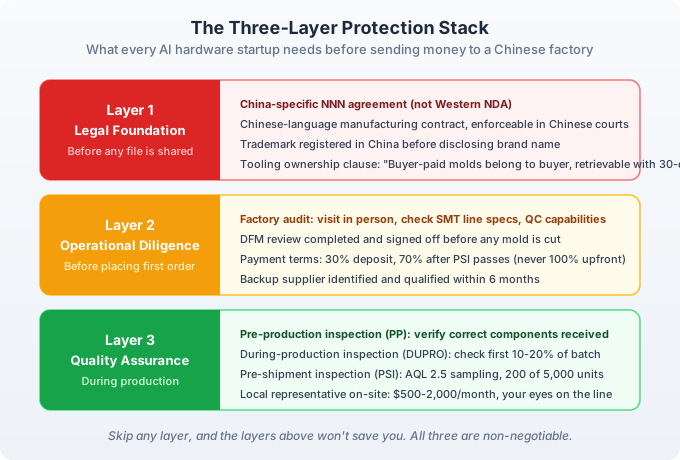
Layer 1: Legal Foundation (Before Any File Is Shared)
- China-specific NNN agreement (not a Western NDA): $1,500-3,000
- Chinese-language manufacturing contract with tooling ownership clause: $2,000-5,000
- Trademark registration in China: $500-1,500
- Chinese utility patent (if applicable): $1,500-2,500
Total: $5,500-12,000. This is the most important money you'll spend. A single pitfall costs 10-50x this amount.
Layer 2: Operational Diligence (Before First Order)
- Factory audit (in-person or third-party): $500-1,500
- DFM review with your top factory choice: included with serious CMs
- Payment terms negotiation: 30/70 standard
- Backup supplier identified: free, just takes time
Layer 3: Quality Assurance (During Production)
- Pre-production inspection (PP): $200-300
- During-production inspection (DUPRO): $300-400
- Pre-shipment inspection (PSI): $300-500
- Local representative on-site: $500-2,000/month
Total QA for a 5,000-unit run: $1,300-3,700. This catches quality fade, spec substitution, and process errors before they become a recall.
The Uncomfortable Truth About Trust
Many founders skip these protections because they "trust" their factory. Here's what Harris Sliwoski's China law team says about that:
"I've worked with my Chinese supplier for years. Am I still at risk? Yes, absolutely. Economic pressure is now forcing even historically reliable suppliers into desperate measures. While long relationships provide a degree of confidence, they are no guarantee against corporate insolvency, outright fraud, or IP theft driven by survival pressures."
Trust is not a legal strategy. Trust is not a contract. Trust is not a quality control system. Trust makes you feel good while your $800,000 walks out the door.
The factories that succeed with foreign startups aren't the ones that "feel" trustworthy. They're the ones that operate under proper legal frameworks, accept standard payment terms, welcome third-party inspections, and respect IP agreements because they understand that their long-term business depends on it.
"China can build anything. The question is whether you've protected yourself from what happens when it doesn't."
We help AI hardware startups set up their China manufacturing — and we can review your exposure in one call.
Bring your product spec and shortlisted factories. We'll review your contracts, IP position, and manufacturing plan — and tell you exactly where you're exposed.