In Shenzhen, you can now build an AI-powered plush toy that talks, listens, and responds for less than the cost of a Starbucks coffee. The chip costs $1. The 4G module costs $2. The cloud AI license costs $1.40. Total BOM: under $11. Retail price: $14.
This isn't a hypothetical. It's happening right now, in factories across Shenzhen's Huaqiangbei district. And it's not just toys — the same cost revolution is transforming every category of AI hardware, from $85,000 humanoid robots to $300 3D printers that outperform $10,000 industrial machines.
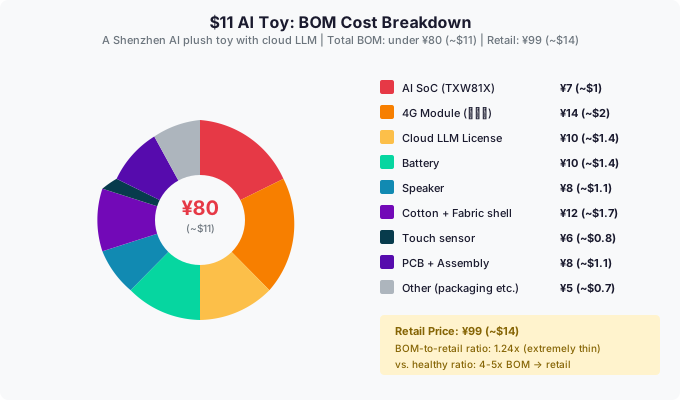
Complete BOM breakdown of a Shenzhen AI plush toy. The entire bill of materials — chip, connectivity, cloud license, battery, speaker, fabric — totals under ¥80 (~$11). Source: Industry analysis, 52audio.
The implications are profound. When the cost of building AI hardware drops this low, the barrier to entry collapses. Anyone can make an AI device. But that's also the problem: when anyone can make it, differentiation becomes the real challenge.
The $11 AI Toy: Anatomy of a Cost Revolution
Let's dissect that $11 AI toy BOM in detail. This is a real product — a plush toy that connects to cloud-based LLMs, responds to voice, and interacts with children:
| Component | Part | Cost (¥) | Cost ($) | Supplier |
|---|---|---|---|---|
| AI SoC | TXW81X (WiFi+Audio SoC) | 7 | ~$1.00 | Zhuhai TaiXin (泰芯) |
| 4G Module | Lierda connectivity module | 14 | ~$2.00 | Lierda (利尔达) |
| Cloud LLM License | Baidu AI Cloud per-unit | 10 | ~$1.40 | Baidu Smart Cloud |
| Battery | Lithium polymer | 10 | ~$1.40 | Generic |
| Speaker | Micro speaker | 8 | ~$1.10 | Generic |
| Cotton + Fabric | Plush exterior | 12 | ~$1.70 | Generic |
| Touch Sensor | Capacitive touch | 6 | ~$0.80 | Generic |
| PCB + Assembly | SMT + hand assembly | 8 | ~$1.10 | Shenzhen CM |
| Other | Packaging, cables | 5 | ~$0.70 | Generic |
| Total | ¥80 | ~$11 |
The chip — a 5mm × 5mm SoC from Zhuhai TaiXin — integrates WiFi connectivity, audio processing, low-power control, and cloud AI access into a single package. It's the same chip platform used in AI printers, AI glasses, smart pet devices, and educational toys across 20+ product categories.
This is the power of supply chain integration at scale. When a chip platform serves 20 different product categories, the development cost is amortized across millions of units. The per-unit cost drops to commodity levels.
But look at the BOM-to-retail ratio: ¥80 BOM → ¥99 retail = 1.24x. A healthy consumer electronics ratio is 4-5x. This product is selling at near-cost. The manufacturer's margin is approximately ¥19 ($2.70) per unit — barely enough to cover shipping, returns, and channel fees.
This is the commoditization trap: when BOM drops this low, everyone can compete on price, and nobody wins.
The $85,000 Humanoid Robot: When Hardware Isn't the Barrier
The same cost dynamics apply at the other end of the spectrum. In March 2026, China Post Securities published a complete teardown of Unitree's G1 humanoid robot — and the results challenged every assumption about robotics economics.
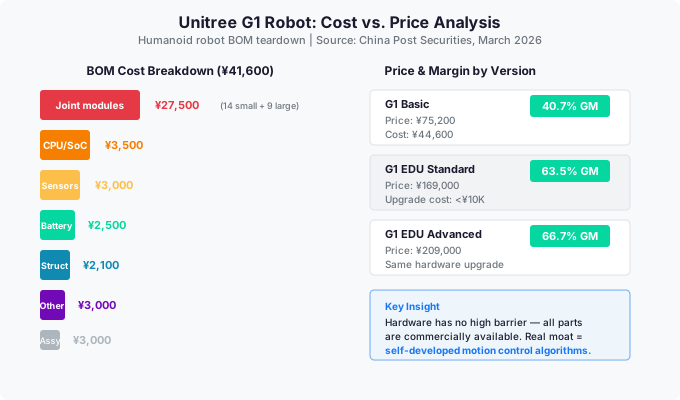
Unitree G1 humanoid robot cost structure. BOM of ¥41,600 against a ¥75,200 retail price yields 40.7% gross margin. The EDU version achieves 66.7% margin on the same hardware. Source: China Post Securities teardown report.
The teardown revealed that G1's hardware has no particularly high barrier. All components are commercially available, off-the-shelf parts:
- Joint modules (14 small + 9 large): ¥27,500 — the most expensive subsystem
- CPU/SoC: Intel + Rockchip — standard industrial computing
- Sensors: Depth cameras and LiDAR from DJI subsidiary
- Battery: Standard lithium pack
- Structure: Aluminum alloy frame
The real moat? Self-developed motion control algorithms. The hardware is a commodity. The software that makes it walk, run, and recover from falls is the competitive advantage.
This explains why Unitree could drop prices so aggressively. The ¥85,000 "slaughter price" wasn't a loss leader — it was a honest reflection of what the hardware actually costs. The previous ¥1,000,000+ price tag was scarcity premium, not manufacturing cost.
And the margin structure is revealing: the basic version has 40.7% gross margin, while the EDU version — which costs less than ¥10,000 more to produce — sells for ¥93,000 more, achieving 66.7% margin. The upgrade from basic to EDU is almost entirely software.
Why Costs Are Collapsing
Three structural forces are driving the BOM revolution:
1. Chip Integration
Five years ago, an AI device needed separate chips for WiFi, Bluetooth, audio processing, sensor fusion, and application logic. Today, single-chip platforms like ESP32-S3 ($2.50), TXW81X ($1), and nRF52810 ($1.50) integrate all of these functions. The PCB shrinks from 4 layers to 2. Component count drops from 40+ to under 15. Assembly time halves.
2. Supply Chain Density
Shenzhen's "half-hour supply chain" means that custom PCB fabrication costs $2 for 5-piece prototyping orders, injection molding tooling starts at $1,500 (versus $8,000-15,000 in the US), and component sourcing happens within walking distance rather than across ocean freight.
One Huaqiangbei merchant described the new "OPC" (One Person Company) model: a single founder uses AI to generate product designs in the morning, sources components in the afternoon, and has a sample on the counter by the next day. Drones — a category that required $100,000+ development budgets in Silicon Valley — can be built in Huaqiangbei for under $1,000 using open-source flight controllers, public molds, and cloud AI.
3. AI Cloud Offloading
The most expensive part of any AI device used to be the NPU — the neural processing unit that runs models locally. But when you offload AI inference to cloud APIs (Baidu, OpenAI, Anthropic), the device only needs a cheap WiFi module and a microphone. The "AI" lives in the cloud. The hardware is just a sensor and speaker.
This is why the $11 AI toy works: it doesn't compute anything locally. It captures audio, sends it to Baidu's cloud, and plays back the response. The $1.40 cloud license is cheaper than any local NPU could ever be.
The Double-Edged Sword
Low BOM is not unambiguously good. It creates three dangerous dynamics:
The Commoditization Trap
When anyone can build an AI toy for $11, everyone does. Huaqiangbei already has "about 40% of counters" doing some form of AI hardware, according to one merchant. Price wars are immediate and brutal. The drone accessories merchant who sells flight controllers to OPC entrepreneurs noted: "When too many people make the whole device, prices get cut through, and returns increase."
The Quality Spiral
When BOM is this thin, there's no margin for quality control. The Romanée (罗马仕) power bank collapse is a cautionary tale: a brand that dominated market share through aggressive pricing eventually faced product fires, 3C certification revocation, factory shutdown, and ¥50M+ in frozen assets. The root cause: a manufacturer (卓翼智造) that was itself losing ¥1.4 billion in 2024 alone, cutting corners on quality to survive.
The Innovation Illusion
Low cost enables rapid iteration, but it also enables lazy product definition. When you can build any hardware for $11, the temptation is to ship products without asking whether anyone actually wants them. The smart viewfinder, the smart mirror, the smart fishing boat — these products exist because they can be built cheaply, not because anyone needs them.
As one Shenzhen hardware veteran put it: "Last year, many products were really just validating market sentiment. Some teams hadn't even figured out user needs before they started building hardware."
How to Win in a Low-Cost World
If cost is no longer a barrier, what is? The answer is the same thing that's always mattered: product definition, software ecosystem, and brand.
1. Own the Category Definition
Bambu Lab didn't win by making cheaper 3D printers. They won by redefining what a 3D printer could be — a consumer appliance instead of a hobbyist tool. Plaud didn't win by making a cheaper recorder. They won by turning recording into an AI-powered workflow tool.
When you define the category, you control the pricing anchor. When you copy an existing category, you're stuck competing on cost.
2. Build the Software Moat
The Unitree G1 robot's 66.7% margin on the EDU version comes from software, not hardware. Plaud's $10/month subscription comes from AI transcription quality, not microphone specs. Bambu Lab's retention comes from MakerWorld's 10M monthly active users, not printer resolution.
Hardware is increasingly a commodity. Software is the only sustainable differentiation.
3. Price for Value, Not Cost
The healthy BOM-to-retail ratio is 4-5x. If your BOM is $11, your retail should be $44-55, not $14. The companies that survive are the ones that charge enough to fund R&D, quality control, customer support, and brand building.
The $14 AI toy is a dead end. The $50 AI toy with better materials, better AI, and a subscription model is a business.
4. Use Low Cost Strategically, Not As Strategy
Shenzhen's low-cost supply chain is an enabler, not a strategy. Use it to iterate faster, test more prototypes, and reach price points that unlock new markets. But don't let low cost become your identity — because the moment a cheaper competitor appears (and in Shenzhen, they always do), you have nothing left.
When the BOM drops to $11, the question stops being "can you build it?" and becomes "should you build it, and can you build something worth paying for?" The founders who answer the second question are the ones who build brands. The ones who only answer the first build commodities.
Building an AI hardware product and not sure how to price it? Aixumo helps founders navigate Shenzhen's supply chain — from BOM optimization to contract manufacturing to quality control. Talk to us.
Previous in Execution Lessons: How to Turn Your AI Agent App into a Standalone Hardware Device
Next in Execution Lessons: Navigating China's Hardware Supply Chain: Common Pitfalls and How to Avoid Them
Whether you have a working prototype or just a hypothesis about what your users want to hold, Aixumo can map the path forward.
Share your current stage. We'll help you identify the hardware route, productization risks, and the practical next move before you spend money on the wrong supplier conversation.