In 2025, Chinese creators raised $244 million on Kickstarter — more than the rest of the world combined. Ten years ago, "Made in China" meant cheap knockoffs on Walmart shelves. Today, it means category-defining brands that Western consumers wait six months to receive.
The shift didn't happen gradually. It happened because a new generation of founders — trained at DJI, Huawei, Tencent, and ByteDance — brought engineering rigor, AI capability, and global ambition to an industry that previously competed on price alone.
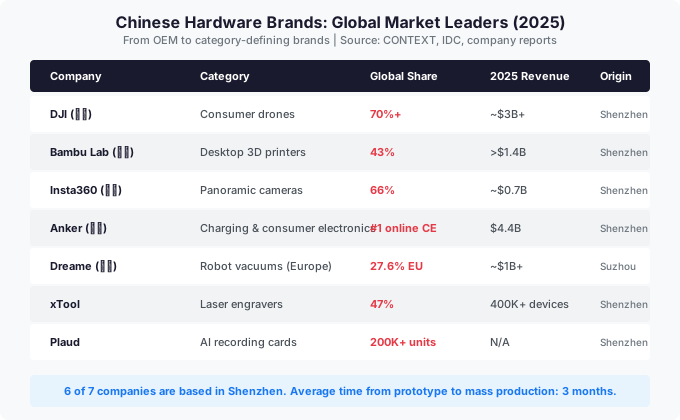
Seven Chinese hardware brands that define their categories globally. Six of seven are based in Shenzhen. Source: CONTEXT, IDC, company reports.
The Old Playbook vs. The New Playbook
Old playbook (2005-2018): Find a Western brand's product → reverse-engineer it → manufacture it cheaper → sell on Amazon or Alibaba → compete on price → race to the bottom. No brand. No IP. No ecosystem. Margins under 5%.
New playbook (2019-present): Find a category that Western brands have ignored or under-served → define a new product form factor → validate demand on Kickstarter → manufacture in Shenzhen at 1/3 the cost → sell direct-to-consumer via DTC + Amazon → build software ecosystem → charge monthly subscription → expand product line.
The companies executing the new playbook aren't hiding their Chinese origin. They're building global brands that happen to be manufactured in China — the same way Apple is an American brand that happens to assemble in China.
Case Study: Bambu Lab (拓竹)
Founded by former DJI consumer drone chief Tao Ye, Bambu Lab applied drone engineering — gyroscope stabilization, laser radar, computer vision — to 3D printing. The result: a desktop 3D printer that auto-calibrates, handles multi-color printing, and works out of the box.
- 2022: First product launched on Kickstarter
- 2023: Named Time Magazine's Best Invention
- 2025: Revenue exceeded $1.4 billion (¥100B+)
- Global market share: 43% of desktop 3D printers (185M+ units shipped)
- Key differentiator: Not hardware specs — but MakerWorld, their community platform with 10M+ monthly active users. Software team now exceeds hardware team.
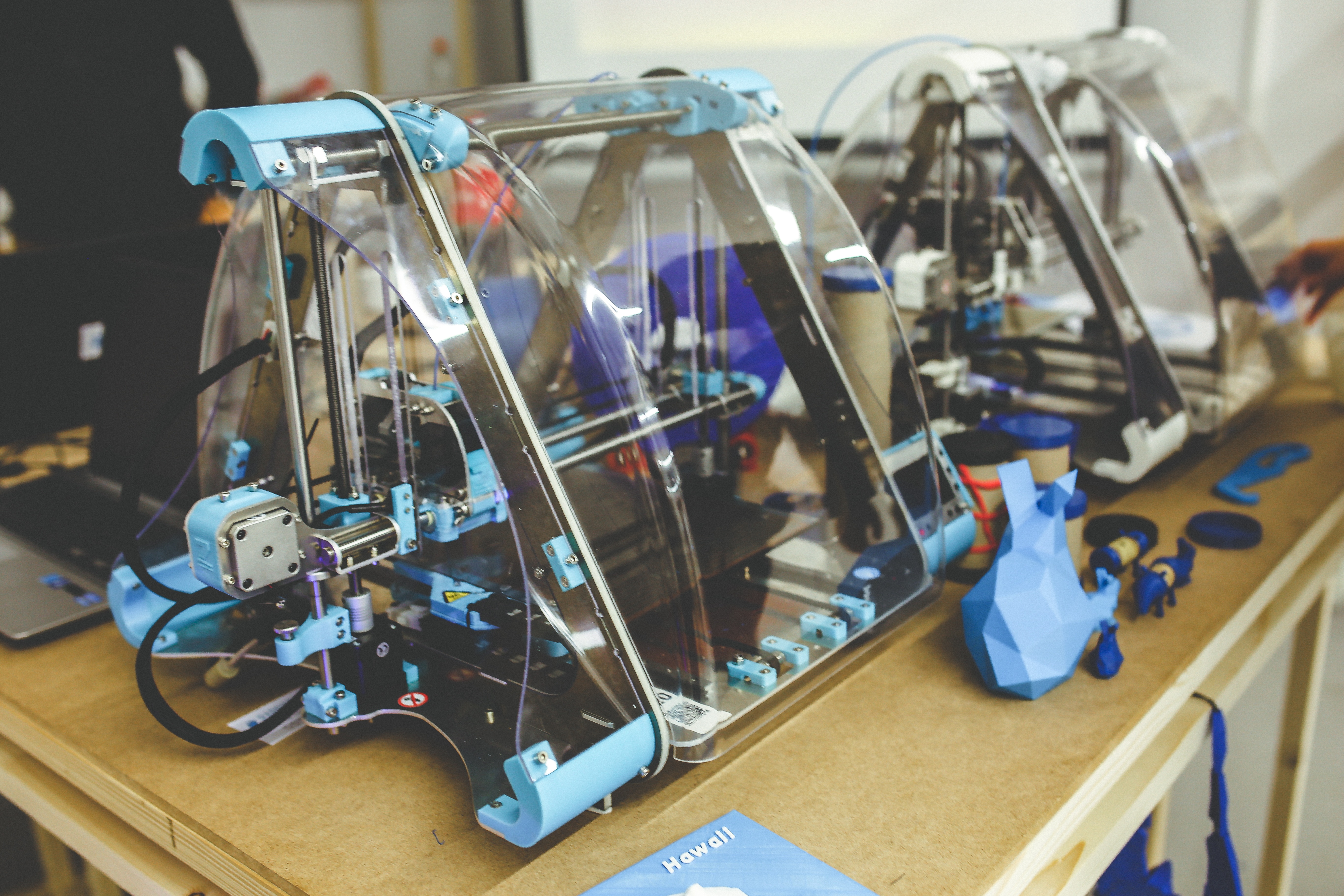
Consumer-grade 3D printing, redefined by a Shenzhen startup in three years. Photo: Wikimedia Commons (CC BY).
Bambu Lab's real innovation wasn't the printer. It was the ecosystem. They open-sourced firmware, encouraged model sharing, and built a community where top creators earn ¥2M+ annually. The printer is the razor. The filament and community are the blades.
Case Study: Plaud
Before Plaud became the AI recording card that sold 200,000+ units globally, it was a small Kickstarter project raising "a few tens of thousands of dollars." The crowdfunding wasn't about the money — it was about validating that consumers would accept a card-shaped recording device.
After validation, Plaud integrated LLM capabilities for automatic transcription and summarization. They launched on TikTok (not Amazon), achieving #1 in their category. Only after establishing the brand did they enter the Chinese market — in September 2025, nearly three years after founding.
The lesson: validate overseas first, then come home. The old Chinese hardware playbook was the reverse — start domestic, then export. The new playbook goes global from day one.
The Supply Chain Speed Advantage
The core competitive advantage of Shenzhen isn't cost. It's speed.
Consider these quotes from founders in the《财经》cover story on China's AI hardware ambitions:
- "In Shenzhen, updating a circuit board takes 12-15 days. In the US, it takes 1-2 months." — Cheng Qi, smart tennis machine founder
- "At 3 AM I finish the PCB design. At 4 AM the factory delivers the sample. At 5 AM I start testing new features. This speed is impossible anywhere else." — Anonymous AI toy founder
- "We went from prototype to mass production in three months. Overseas brands take a year." — Cheng Qi
This speed advantage compounds. Three-month product cycles mean five iterations in the time a US competitor does one. By the time a Silicon Valley startup reaches EVT, the Shenzhen team has already shipped and collected user feedback from real customers.
The supply chain density makes this possible. Within a 10-kilometer radius of Shenzhen's Huaqiangbei, you can source every component, print every enclosure, fabricate every PCB, and assemble every unit — often within the same week. One founder described it as the "half-hour supply chain": half the components within 10km, 80% within 40km, and same-day delivery for rush orders.
The Kickstarter Validation Path
Kickstarter has become the de facto PMF (Product-Market Fit) validation tool for Chinese hardware startups. The data is remarkable:
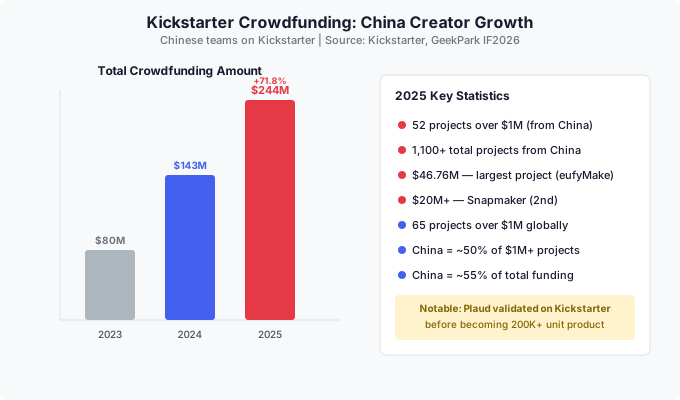
Chinese creators raised $244M on Kickstarter in 2025, up 71.8% year-over-year. Source: Kickstarter, GeekPark IF2026.
Key statistics from 2025:
- 52 projects from Chinese creators exceeded $1M in crowdfunding
- 1,100+ total projects launched from China
- $46.76M — the largest project (eufyMake UV printer by Anker), breaking Kickstarter's all-time record
- Chinese projects account for ~50% of all $1M+ projects on the platform
The Kickstarter strategy serves three purposes:
- Demand validation: If 5,000 people pre-pay $200 for a product that doesn't exist yet, you have PMF proof. This de-risks the manufacturing investment.
- Community building: Kickstarter backers become evangelists. They forgive delays, provide feedback, and generate organic content.
- Investor signal: A successful Kickstarter campaign is the strongest possible signal to venture investors. Plaud, Bambu Lab, and dozens of others used crowdfunding as a springboard to Series A and beyond.
The "Hardware PMF" Framework
Henri Peng, Kickstarter's China Chief Strategy Representative, offers a framework for identifying viable AI hardware products:
Three rules:
- Find the blind spot in a mass market (大众市场找盲区)
- Hit the real pain point in a vertical (垂直领域打刚需)
- Build a business in a niche (细分赛道做生意)
Examples of this framework in action:
- DJI: Mass market = photography. Blind spot = aerial photography. Product definition = "a flying camera"
- Narwal (云鲸): Mass market = floor cleaning. Blind spot = mopping. Product definition = "a mopping robot"
- EcoFlow: Mass market = electricity. Blind spot = fast-charging portable power. Product definition = "fast-charging power station"
- Plaud: Mass market = recording. Blind spot = AI transcription/summarization. Product definition = "an AI note card"
The Tier-2 App heuristic: Look at the second-tier apps on your phone — the ones you use frequently but aren't your primary tool. Camera, voice recorder, calculator, flashlight, timer. Each of these is a candidate for hardware-ification. The phone version is adequate; a dedicated hardware version can be significantly better because it removes interruptions, optimizes form factor, and enables new interaction patterns.
The Business Model Revolution
The most important shift in Chinese AI hardware isn't the technology — it's the business model.
Old model: Sell hardware once → compete on price → low margin → no recurring revenue → eventually commoditized.
New model: Sell hardware as a service entry point → charge monthly subscription for AI features → high margin → recurring revenue → software updates improve product over time → hardware becomes platform.
"Before, hardware was a one-time transaction. Now, with LLMs, hardware becomes the entry point for continuous service." — Zhang Han, Sequoia China
This is why investors are pouring capital into AI hardware. The total addressable market isn't the device — it's the device multiplied by the subscription period. A $199 AI recorder that charges $10/month for premium AI features has a 3-year customer lifetime value of $559, not $199.
The Risks Nobody Talks About
The new playbook isn't without peril. Three risks deserve attention:
1. Internal commoditization. When a category is validated in China, dozens of competitors enter within months. The smart tennis machine that was novel in 2025 now has "dozens of teams" building similar products in Shenzhen. Price wars are brutal and fast.
2. Geopolitical headwinds. The US FCC added DJI to its "covered list" in December 2025. The 2026 NDAA prohibits the Department of Defense from purchasing Chinese-made 3D printing equipment. Chinese AR brand Viture faced a patent injunction in Germany. The "China-made" label is becoming a compliance liability in Western markets, not just a cost advantage.
3. IP vulnerability. Many Chinese hardware startups spend less than 5% of revenue on R&D and lack dedicated IP teams. FTO (Freedom to Operate) analysis is often skipped or done cheaply. As brands grow, this becomes existential — patent litigation in the US costs $5-10M per case.

Shenzhen's skyline — the manufacturing capital that's becoming a brand capital. Photo: Wikimedia Commons (CC BY-SA).
What This Means for You
If you're an overseas founder considering China's supply chain for your AI hardware product, the new playbook offers a clear path:
- Don't build a factory. Define a product, own the brand, and let Shenzhen handle manufacturing. The ecosystem is mature enough that you can go from concept to EVT in 3-6 months.
- Validate before you commit. Use Kickstarter or Indiegogo to test demand before investing in tooling. A $50K crowdfunding campaign can save you $500K in wasted manufacturing.
- Build software, not just hardware. The hardware is the platform. The AI software — voice recognition, contextual awareness, personalization — is what creates lock-in and justifies premium pricing.
- Plan for geopolitical risk. Design your supply chain with flexibility. Consider dual sourcing, and ensure your data privacy and IP strategies are solid before entering Western markets.
- Get local expertise. The Shenzhen supply chain is powerful but opaque. Having a partner who understands both sides — the founder's product vision and the factory's manufacturing reality — is the difference between a smooth launch and a costly failure.
The new Chinese hardware founders aren't competing on price. They're competing on product definition, AI capability, and speed of iteration. If you're not using Shenzhen's supply chain, your competitor is — and they'll ship three versions before you ship one.
Ready to build your AI hardware product with China's supply chain? Aixumo connects overseas founders with vetted Shenzhen manufacturers, handles quality control, and manages the entire production journey from prototype to mass production. Get started.
Previous in China Supply Chain: Navigating China's Hardware Supply Chain: Common Pitfalls and How to Avoid Them
Next in China Supply Chain: The Shrinking BOM: How China Made AI Hardware Affordable
Whether you have a working prototype or just a hypothesis about what your users want to hold, Aixumo can map the path forward.
Share your current stage. We'll help you identify the hardware route, productization risks, and the practical next move before you spend money on the wrong supplier conversation.